
Rotary Encoder
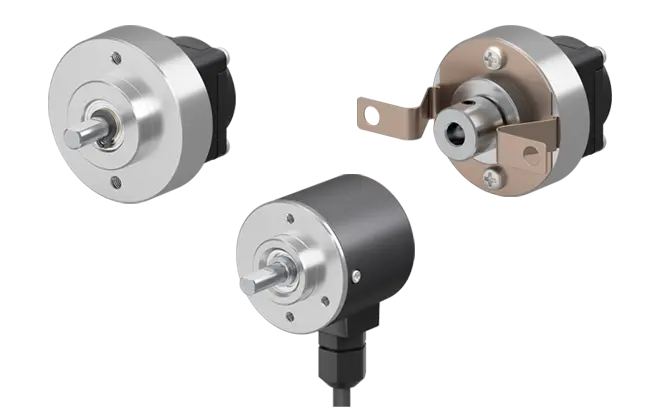
In addition to being environmentally resistant design to dust and vibration, it is also compact, low cost, and has delivered quickly. It detects the position, speed, and rotation direction in conveyors, belts, pulleys, and other mechanisms with high accuracy, which contributes to the construction of predictive maintenance systems.
Rotary Encoder
Tổng quan và thông tin liên quan
What is a Rotary Encoder?
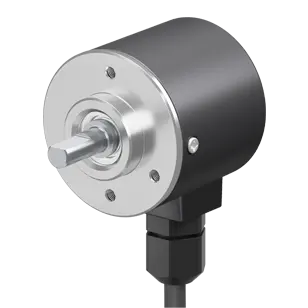
A rotary encoder is a sensor that can detect changes in mechanical position (angle, rotation speed, and rotation direction of a rotating shaft).
- In mechanisms such as conveyors, belts, and pulleys, detecting the actual position, speed, and rotation direction can ensure accurate operation of the equipment.
- Position and velocity detection allows precise synchronization of operation timing with other devices.
- By detecting abnormal rotation speeds, machine failure and workpiece jams can be detected early on.
Example of Passive Shaft Operation of a Conveyor in a Current-Carrying Inspection System
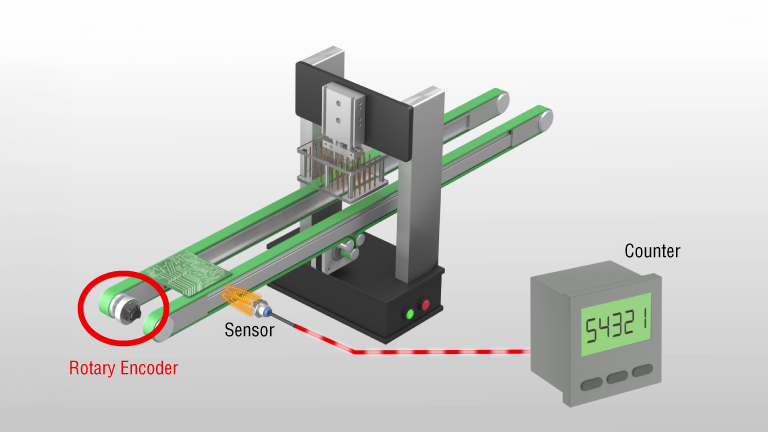
(1) An encoder is equipped with the passive shaft to monitor the movement of the mechanism tip. Detects a workpiece with a separate sensor.
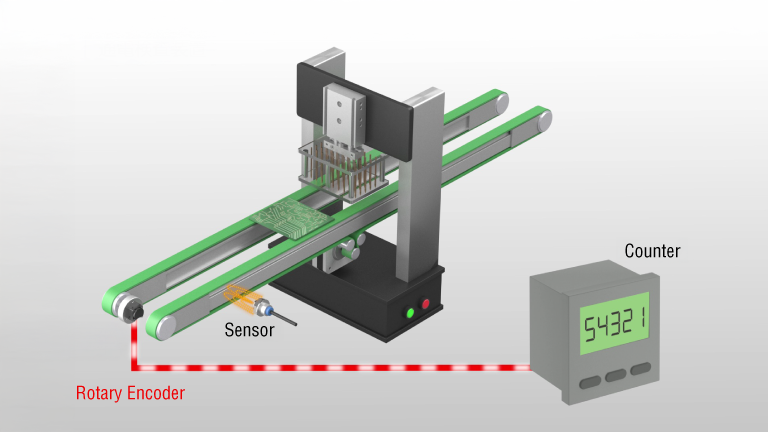
(2) After detection, the encoder rotates and the conveyor moves forward until a predetermined count is reached.
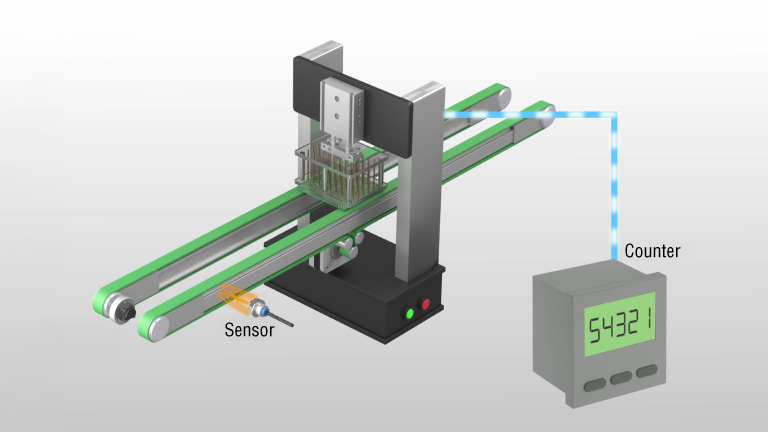
(3) When the default count is reached, the conveyor stops.
Optical and Magnetic
Rotary encoders are available in optical and magnetic types.
What is Optical Type?
Optical encoders consist of a disk with a slit, a light-emitting element and a light-receiving element.
Light is shone on a disk mounted on a rotating shaft, and a light-receiving element generates pulses by detecting reflection/non-reflection or transmission/non-transmission, enabling detection of rotation angle, rotation speed, and rotation direction.
Advantages
- Since the information that received light is output as it is, it is less affected by temperature changes and disturbance magnetic fields.
- Since the resolution is determined by the number of slits, high resolution can be achieved.
Disadvantages
- Since information that received light is output as it is, there is a possibility of false detection such as intrusion of dust or oil.
- Vibration may shake the disk, leading to false detection.
The higher the resolution, the more this risk tends to increase.
What is Magnetic Type?
Magnetic encoders consist of a permanent magnet and a magnetic sensor.
The rotation angle, rotation speed, and rotation direction can be detected by the magnetic sensor reading the orientation of the permanent magnet attached to the rotating shaft.
Advantages
- The simple configuration enables a compact encoder.
- Since the position is detected based on the orientation of the magnet, it is not easily affected by debris, condensation, or vibration, thus maintaining stable performance.
Disadvantages
- There is a limit to the resolution because it depends on the detection accuracy of the magnetic sensor and the machining accuracy of the poles of the permanent magnet.
- It is susceptible to interference from external magnetic fields and magnetic materials (e.g., linear motors), which may affect angular accuracy.
Difference Between Optical and Magnetic
| Type | Optical | Magnetic |
|---|---|---|
| Resolution | Capable of handling high resolution | Specifications are slightly inferior to optical, but sufficient for general positioning applications |
| Environment Resistance | Susceptible to dust, high humidity, and vibration | High resistance to pollutants and vibration |
| Magnetic Resistance | Good magnetic resistance, as it is not affected by magnetic fields | Susceptible to strong magnetic fields (e.g., linear motors) |
Oriental Motor Rotary Encoder
Oriental Motor's rotary encoders are compact, thin, and lightweight magnetic incremental type encoders.
Environmental and Vibration Resistance
Since a magnetic encoder is used, it is not easily affected by dust and other debris, high humidity, and vibration, thus maintaining stable performance.
Quick Delivery and Reasonable Price
Shipping Lead Time: 11 days (Quantity: 1 to 10 units)
Extensive Resolution Lineup
100 to 4,000 P/R 14 different resolutions
Output Circuit Type
3 types available: line driver output, voltage output, and open-collector output.
The open-collector output supports power supply voltages from 5 to 24 VDC inputs.
Can Be Used in High Temperature Environments
The open-collector output can be used in up to 70 °C, the line driver output* and voltage output can be used in environments up to 85 °C.
- *For the dust and water resistant IP65 type, both open-collector output and line driver output are rated up to 70 °C.
3 Types to Choose From Depending on the Application
3 types are available for different applications.
Standard
Frame Size: ϕ40
Degree of Protection: IP20
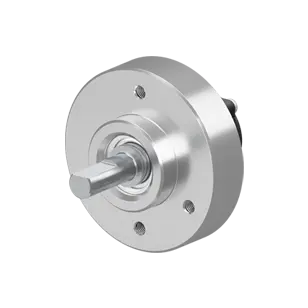
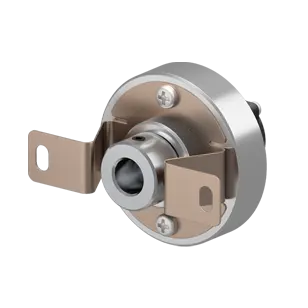
Compact
Frame Size: ϕ30
Degree of Protection: IP20
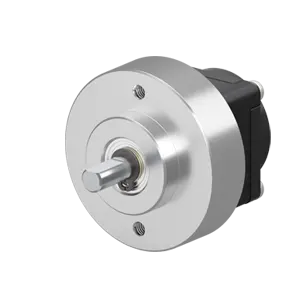
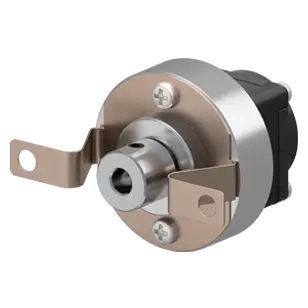
Dustproof and Water-Resistant
Frame Size: ϕ40
Degree of Protection: IP65
Application Examples
Here are some examples of rotary encoder applications.