
The Brushless Motors (PM Motors) 750 W for Improved Efficiency in Tableware Disinfection and Storage Machines
| Industries | Food manufacturing and packaging |
|---|---|
| Process and Equipment Name | Tableware disinfection and storage machine |
| Issue | Space saving, energy saving, efficiency |
Larger Cabinet Size and Energy Saving for Tableware Disinfection and Storage Machine
Existing Problems/Requests
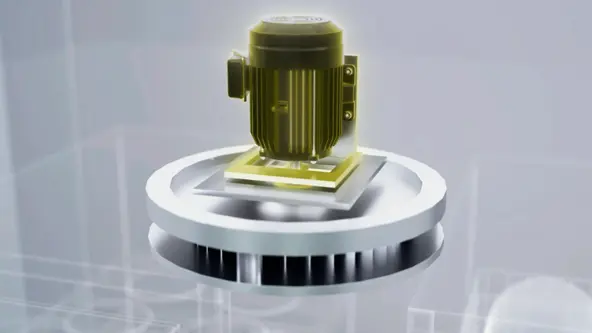
- The three-phase AC motor 750 W used for the hot air circulation of tableware disinfection and storage machines is large and heavy.
- The three-phase AC motors make narrow the cabinet space.
- For the development of new models, we want to increase processing power by effectively using space while maintaining the size of the chassis.
Solution: Space Optimization and Energy Savings in Tableware Disinfection and Storage Machines
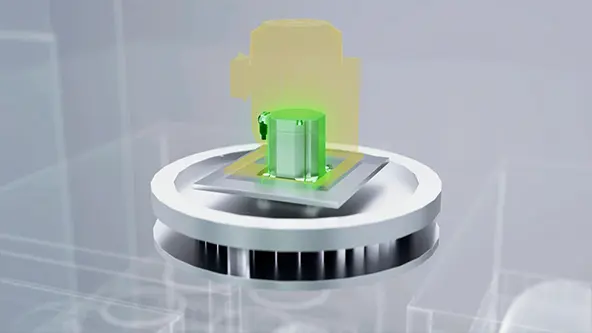
A tableware disinfection and storage machine is an equipment that contains cookware, tableware and disinfects them with hot air. One of the key challenges in developing new models of tableware disinfection and storage machines is to increase efficiency while maintaining the same size of the enclosure. By replacing the three-phase AC motor used in the vhot air circulation with a brushless motor (PM motor) 750 W, increasing the internal cabinet size while maintaining the enclosure size and energy savings can also be achieved.
Smaller Motors for Greater Efficiency
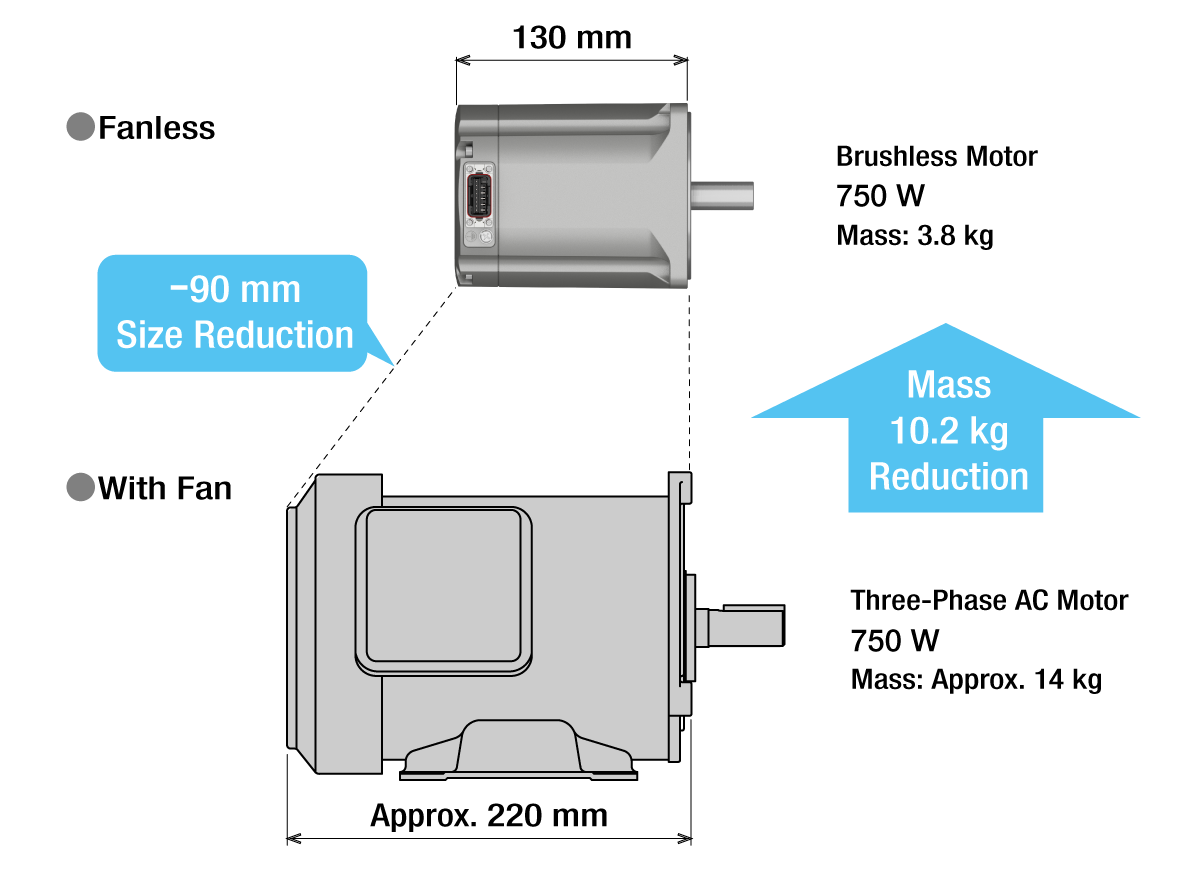
Brushless motors (PM motor) use permanent magnets in the rotor, making them highly efficient and generating less heat. The low heat generation enables a fanless structure. Compared to AC motors of the same output power, the round shaft type is compact and lightweight, with a frame size of 104 mm, a length of 130 mm, and a mass of 3.8 kg. This allows for increased processing capacity and efficiency by increasing the internal cabinet size while maintaining the enclosure size.
Example of Downsizing With the 750 W Brushless Motor (PM Motor)
Size and Mass Comparison With Three-phase AC Motor of the Same Output Power
Motor Size (mm)
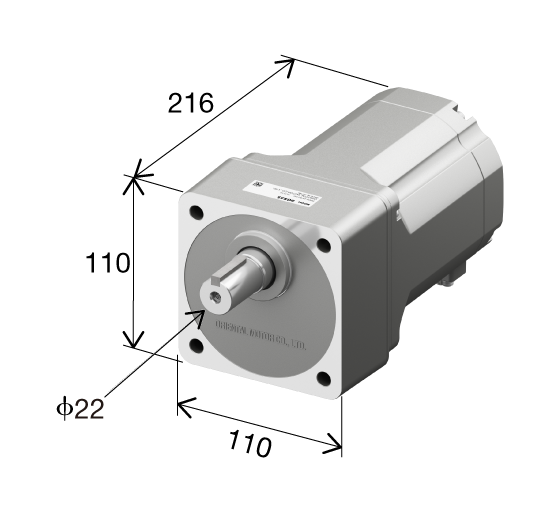
Parallel Shaft Gearhead
Mass: 6.8 kg
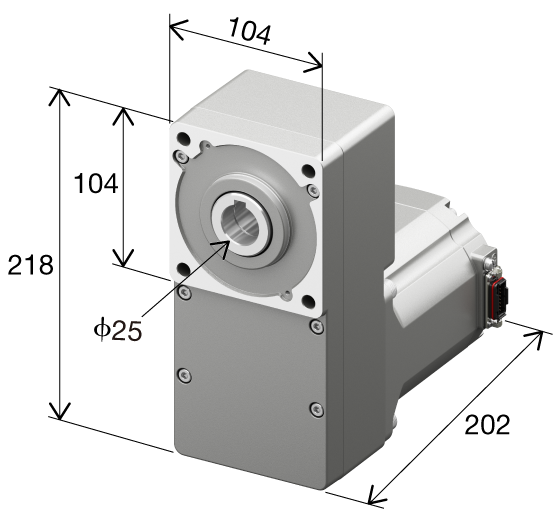
Hollow Shaft Flat Gearhead
Mass: 8.4 kg
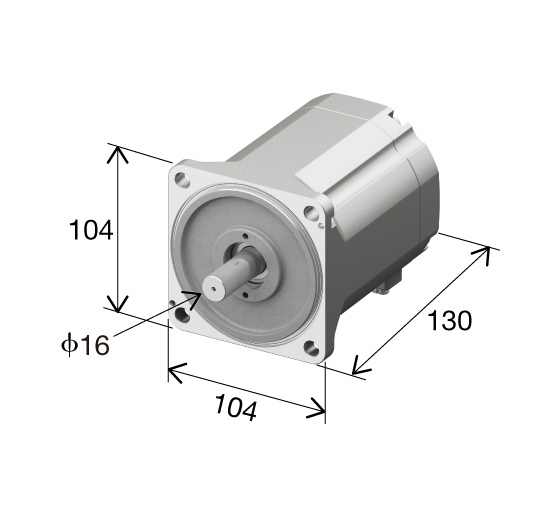
Round Shaft
Mass: 3.8 kg
IE5 High-Efficiency Motors That Reduce Electricity Costs and CO2 Emissions
The 750 W brushless motor (PM motor) is a high-efficiency motor that meets the standards of the IE5*. It contributes to reducing electricity costs and CO2 emissions.
- *Efficiency standard value (%) for speed control motors (rated speed 1801-6000 r/min) based on the international standard IEC TS 60034-30-2.
Energy-Saving Effect (Reference Value for 1 Unit)
Electricity costs and CO2 emissions can be reduced compared to 750 W induction motor (IE3).
| Brushless Motor 750 W + Inverter |
IE3 Standard Value (82.5 %)* Induction Motor 750 W |
Annual Reduction | |
|---|---|---|---|
| Annual Electricity Consumption | Approx. 7400 kWh/year | Approx. 7960 kWh/year | Reduced by 560 kWh/year |
| Annual Electricity Cost | Approx. 167,800 JPY/year | Approx. 180,600 JPY/year | Reduced by 12,800 JPY/year |
| Annual CO2 Emissions | Approx. 3380 kg/year | Approx. 3640 kg/year | Reduced by 260 kg/year |
- *Efficiency standard value (%) for induction motors (4 poles, 50 Hz) based on the international standard IEC 60034-30-1.
[Operating Conditions]
Operating Hours: 24 hours/day, 365 days/year
Unit Price of Electricity: 22.68 JPY/kWh
CO2 Emission Factor: 0.457 kg-CO2/kWh
Inverter Drive Compatible
Brushless motor (PM motor) 750 W is a three-phase motor that can be controlled in combination with an inverter (only inverters that can be combined with PM motors can be used).
This has the advantages of enabling speed control (300 to 4000 r/min), the use of functions available in the inverter, and network control by using a network-compatible inverter. In addition, the inverters currently in use can be used without modification, which will reduce the time and effort required for installation and modification.
Note
Combinable inverters are inverters that can be combined with PM motors.
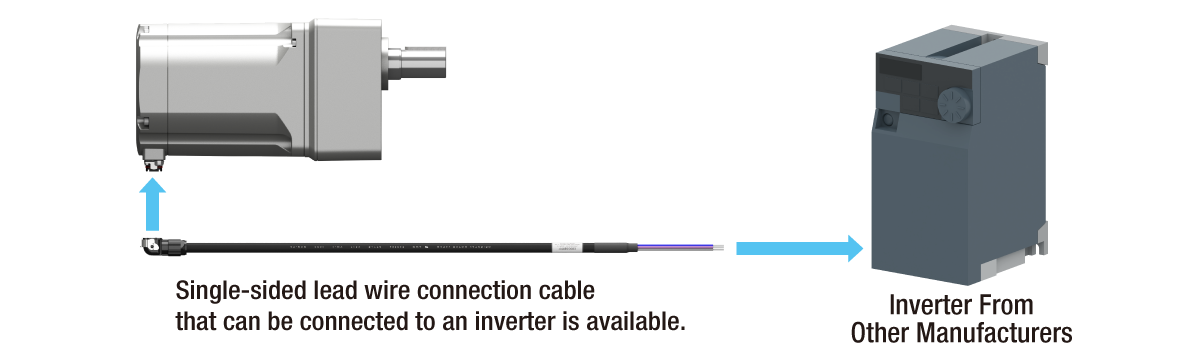
Combination characteristics data and reference parameters for inverters from other manufacturers are available.
Refer to our website for details.
Proposed Product: Brushless Motor (PM Motor) 750 W
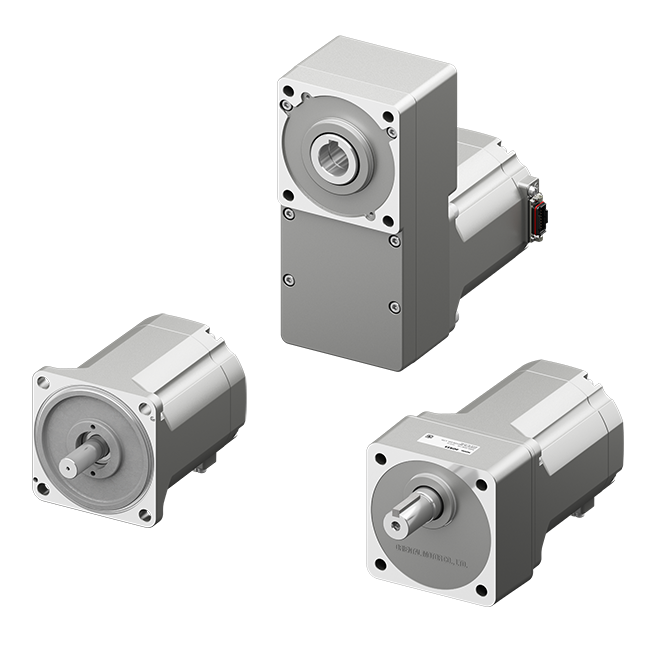
Output Shaft Type
- Parallel Shaft Gearhead
- Hollow Shaft Flat Gearhead
- Round Shaft Type
In addition to product inquiries, please contact us about any issues you may have, or to request materials and samples.
Technical Manual for Brushless Motors, Useful for Equipment Development, Now Available

For those who handle motors for mass production equipment. Technical explanations of brushless motors such as structures and control principles, as well as the advantages of using the equipment, are compiled in a single volume. This is an essential resource for equipment research, development, and design.
- User registration and login are required for downloading. Please contact us for the printed version.